
Strategy
Should you turn on ChatGPT ads in 2026?
This is a question you only have to answer if answering it costs something.
By hand, it costs a great deal. So people are doing what our industry always does when measurement is expensive: forming opinions. Taking a view. Having a point of view about a channel that has been open for five months and publishes no benchmarks.
An opinion is what you buy when a measurement is out of budget.
Here is the measurement, and then here is what it costs.
By hand: too much work, not enough juice
Two facts, held together.
The spend you can place is small. OpenAI launched advertising in February 2026 at a $60 CPM behind a $200,000 minimum. According to AdExchanger’s reporting, the advertisers who cleared that bar then couldn’t deploy the money — there wasn’t enough inventory to absorb it. Six-figure budgets, nowhere to put them.
The cause is structural. Ads serve only to logged-in adults on the Free and Go tiers. Every paid seat above that is ad-free. They serve only when a conversation carries commercial intent. The headline traffic number is not your addressable inventory and is not close to it.
The work is large, and none of it transfers. There are no keywords. Targeting runs on context_hints — a freeform text array at ad group level, which OpenAI describes as thematic guidance, not exact match. There are no audiences. No customer match. No lookalikes. No retargeting. Geography and context hints are the entire control surface.
The measurement stack is assembly required: pixel, Conversions API, event deduplication, offline backfill. And there are no published benchmarks, so when the numbers arrive you won’t know whether they’re good.
Now hold both. Five figures a month of available spend, against the setup burden of a new channel built from parts. Every hour your best analyst spends here is an hour off the account where the money actually moves.
That ratio is not challenging. It’s disqualifying. By hand, the answer is no, and it stays no until inventory grows.
The friction is the moat
The auction is soft because the channel is annoying.
No keywords, so you can’t plan your way in — only test. No audiences, so a decade of learned levers don’t exist here. No benchmarks, so nobody can tell you what good looks like. Each of those is a sound reason for a competent team to deprioritise the channel. Most have.
That deprioritisation is the entire opportunity. Thin competition isn’t something OpenAI built. It’s the residue of a channel that costs more trouble than the available spend justifies.
Which means the barrier and the opportunity are the same object. Remove the trouble and you collect a soft auction that exists precisely because everyone else did the sensible thing.
It has a short half-life. The minimum went $200,000 → $50,000 → zero between February and May. Criteo cut its own entry to $10,000. Self-serve is open to any US advertiser. The barrier keeping your competitors out is being dismantled on a published schedule, by a company that wants them in.
With Sturnix: you link the account
Sturnix does not have a ChatGPT ads strategy.
It has an allocation engine. ChatGPT is an account you link.
Nothing here is special-cased. The Advertiser API is live — full CRUD across campaigns, ad groups, ads and creative, plus insights and a conversions API. Sturnix already reads, decides and writes across your other channels against a single outcome. This is a fourth endpoint.
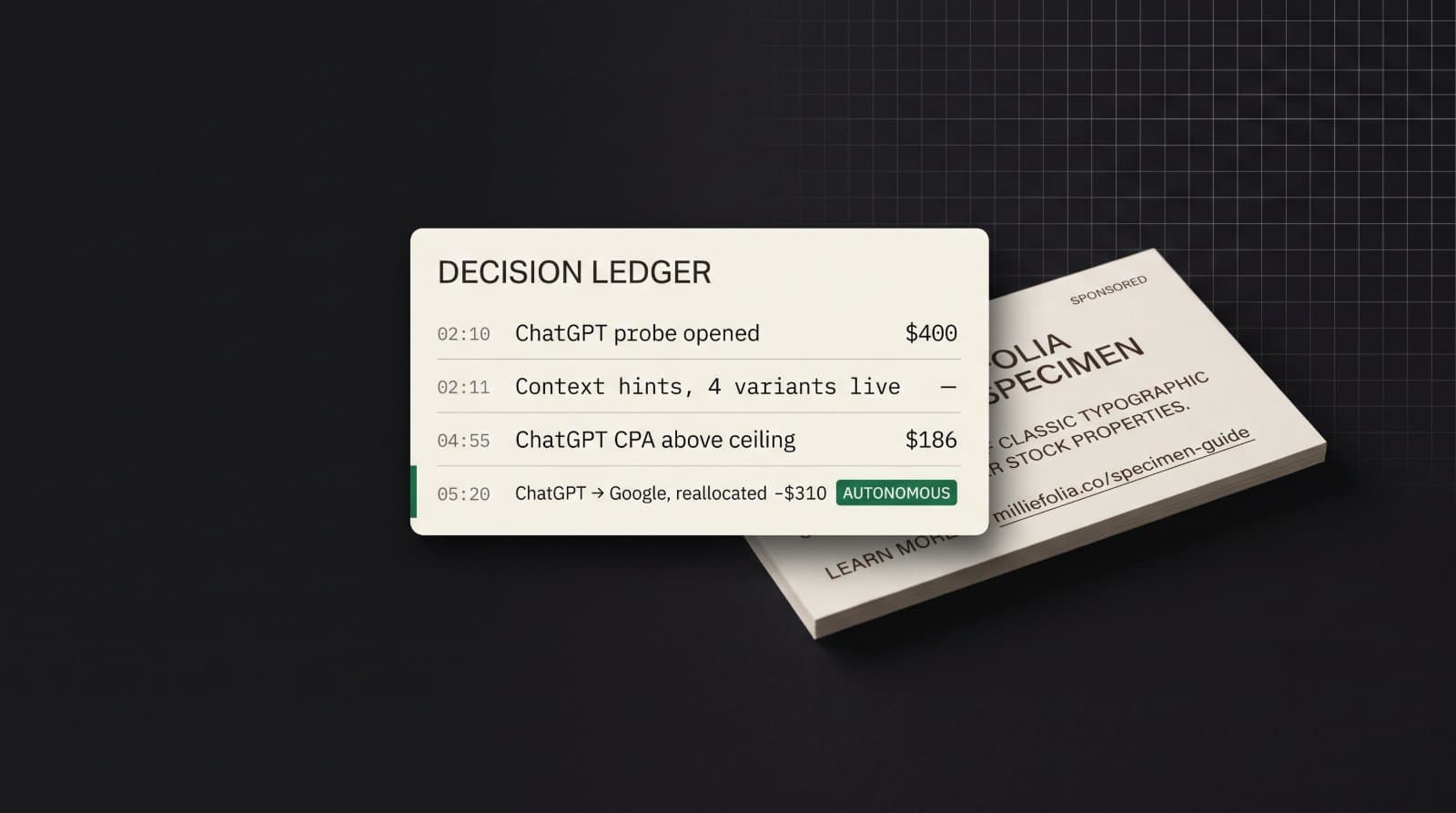
You link the account. Sturnix opens a probe: a small, bounded allocation, measured against the same downstream outcome as everything else you run. Then one of two things happens.
If there’s efficiency in the channel, Sturnix finds it, and budget moves toward it while the auction is still soft.
If there isn’t, budget moves back to the channel that’s working. In days. Automatically. Written to the ledger with a timestamp and a figure.
That second branch is the point, and it’s the one people miss. Reallocation isn’t a failure path bolted on for this post. It’s what the engine does every night across every channel you’ve linked. ChatGPT ads doesn’t get an exception. It gets a probe, and it either earns the budget or gives it back.
So you never form the opinion. You never take the view. You never spend a month of a senior analyst’s time proving out a channel that might hold five figures.
You don’t need to be right about ChatGPT ads. You need it to be cheap to find out.
Engineered autonomy, not a script
Two mechanics make this channel hostile to the wire-an-LLM-to-an-API approach.
Reviews gate serving. Every ad clears review before it runs, tracked through a review_status field. OpenAI says reviews typically take minutes — but the cost isn’t zero, and it’s paid on every change. A system that treats ad copy as a free variable, rewriting it hourly because it can, will live in the queue. Changes have a price. Anything that doesn’t model the price will look extremely busy and achieve nothing.
Delivery watches your pacing. OpenAI’s monetization lead has said the ad shown in a conversation isn’t selected on relevance alone — it also weighs how much of the advertiser’s daily budget is already spent, and the bid. Read that twice. Pacing is an input to delivery, not just an output of it. A system that dumps budget early doesn’t only overspend. It changes what it can win for the rest of the day.
Then the data. Insights returns impressions, clicks and spend at daily granularity. On a channel this thin, one day is noise. Anything that reacts to yesterday will be wrong roughly half the time, with total confidence.
Rolling windows instead of flinching. Pricing a change before making it. Pacing against a model that is watching your pacing. That is the difference between automation that runs and automation that works.
The B2B problem nobody’s writing about
If you sell to businesses, there’s a headwind the enthusiasm has skipped.
Ads serve to Free and Go. Plus, Pro, Business, Enterprise and Education seats are ad-free.
In B2B, the more budget authority your buyer has, the more likely their employer bought them out of your inventory. The VP you want doesn’t see your ad. Her company expensed her out of the auction.
Not fatal, and the reason matters. Mid-market buying committees are wide, and whoever builds the shortlist is almost never whoever signs it. The analyst, the ops lead, the practitioner researching on a personal account — they’re in the inventory, and they decide what gets evaluated at all. OpenAI’s own API documentation uses “productivity” and “team collaboration” as its worked targeting example, which tells you who they think this is for.
But the honest framing is shortlist influence, not demand capture. Size the probe accordingly. Don’t let anyone sell you pipeline.
Who should not link this account
Anyone outside the US. Self-serve and the API are US-focused. Other markets run managed-only through agency partners. If you can’t buy it, this isn’t a decision. It’s a calendar entry.
Anyone in a restricted category. Political, adult, and parts of regulated finance and health are restricted. Check the live policy against your vertical. The list moves.
Anyone whose brand can’t absorb the trust cost. An Ipsos survey in January 2026 found 63% of US adults say ads in AI search results would reduce their trust in the output. A Partnercentric survey put it at 57% for trust in the advertised brand itself. On an impulse purchase, noise. On a considered B2B purchase, not noise.
Anyone who can’t say what their current channels cost per outcome. A new channel doesn’t fix an unmeasured one. It gives the waste somewhere fresh to hide.
The verdict
ChatGPT ads in 2026 is a small, awkward, cheap channel with a complete API and a closing window.
Small and awkward is why your competitors aren’t there. Cheap and complete is why you can be.
By hand, don’t. The arithmetic is not close and your analyst’s hours are worth more elsewhere.
Linked to an engine that already allocates across your channels, the question dissolves. Sturnix opens a probe, measures it against the same outcome as everything else, and either finds the efficiency or moves the money back to the channel that’s working. Every decision timestamped, figured, and written to a ledger you can audit line by line.
No vibes. Just science.
Before you link a new channel, find out what your current ones cost you. Export your last 90 days and run the free audit. It takes a CSV and returns where your spend actually went.
FAQ
Are ChatGPT ads worth it for B2B in 2026?
By hand, no. Inventory is limited and the setup burden is high, so the work-to-spend ratio doesn't justify a person's time. Run through the Advertiser API by a system already allocating across your other channels, the cost of testing approaches zero — and the current soft auction is worth collecting while it lasts.
Is there a ChatGPT Ads API?
Yes. OpenAI's Advertiser API is live and covers campaigns, ad groups, ads, files and insights, with keys issued from Ads Manager. Each key is scoped to a single ad account. Managing multiple accounts programmatically requires contacting OpenAI directly.
How do you target ChatGPT ads without keywords?
Through context hints: a freeform text array set at ad group level, described by OpenAI as broad thematic guidance rather than exact-match keywords. There is no keyword bidding, no customer match, no lookalikes and no retargeting. Geography and context hints are the whole control surface.
Why is ChatGPT ad inventory so limited?
Ads serve only to logged-in adults on the Free and Go tiers, and only on conversations carrying commercial intent. Every paid tier above Go is ad-free. Early advertisers with six-figure minimum commitments were reportedly unable to spend them because inventory couldn't absorb the budget.
Do ChatGPT ads reach B2B decision-makers?
Often not. Business and Enterprise seats are ad-free, so senior buyers at larger accounts sit outside the inventory entirely. The realistic use is influencing the researcher who assembles the shortlist, not capturing the person who signs.
What happens if ChatGPT ads don't work for my account?
With an allocation engine, the budget moves back to the channel that is working, in days, without anyone deciding. Reallocation isn't a special case for ChatGPT — it's what the engine does nightly across every linked account. The channel earns the budget or gives it back.
Is the ChatGPT ads window closing?
Yes, visibly. Minimum spend went from $200,000 to $50,000 to zero between February and May 2026, and self-serve is now open to all US advertisers. The soft auction is a function of low participation, and participation is rising.
Claims ledger
Every factual claim in this post, with its source. Figures we could not trace to a primary source or a named survey were left out.
| Claim | Source |
|---|---|
| The Advertiser API is live, with CRUD across campaigns, ad groups, ads and files, plus an insights endpoint | OpenAI, Advertiser API Overview |
| API keys are scoped to one ad account; multi-account access requires contacting OpenAI | OpenAI, Advertiser API Overview |
Ads require review before serving, tracked via review_status; reviews typically take minutes | OpenAI, Advertiser API Overview |
Targeting uses context_hints, a freeform array at ad group level — not keyword bidding | OpenAI, Advertiser API Quickstart |
The documented creative format is chat_card | OpenAI, Advertiser API Quickstart |
| Measurement runs on a JavaScript pixel and a Conversions API; insights returns impressions, clicks and spend | OpenAI, Ads documentation |
| Ads are clearly labelled and remain distinct from ChatGPT's responses | OpenAI, Advertise in ChatGPT |
| The channel launched February 2026 at a $60 CPM behind a $200,000 minimum commitment | AdExchanger, May 2026 |
| Early advertisers could not spend their committed budgets due to insufficient inventory | AdExchanger, May 2026 |
| The minimum fell to $50,000 in April and was removed with self-serve — Benji Shomair, VP of Monetization, OpenAI | AdExchanger, May 2026 |
| Ad selection weighs conversation content, user profile, remaining daily budget and bid price — Asad Awan, OpenAI ad monetization | AdExchanger, May 2026 |
| Advertisers receive aggregated metrics only, with no access to conversations or user-level data | AdExchanger, May 2026 |
| 63% of US adults say ads in AI search results would reduce their trust in the output (Ipsos, January 2026) | EMARKETER |
| 57% say ads in AI chatbots would reduce trust in the advertised brand (Partnercentric) | EMARKETER |
| Criteo reduced ChatGPT campaign minimums to $10,000, from $50,000 | EMARKETER, June 2026 |